PDF Ebook The Kaufman Repertoire for Black and White: A Complete, Sound and User-friendly Chess Opening Repertoire, by Larry Kaufmann
From now, discovering the completed site that offers the finished books will certainly be many, but we are the trusted website to check out. The Kaufman Repertoire For Black And White: A Complete, Sound And User-friendly Chess Opening Repertoire, By Larry Kaufmann with simple link, easy download, as well as completed book collections become our better services to get. You can discover and use the benefits of selecting this The Kaufman Repertoire For Black And White: A Complete, Sound And User-friendly Chess Opening Repertoire, By Larry Kaufmann as every little thing you do. Life is consistently establishing and also you need some new book The Kaufman Repertoire For Black And White: A Complete, Sound And User-friendly Chess Opening Repertoire, By Larry Kaufmann to be referral constantly.
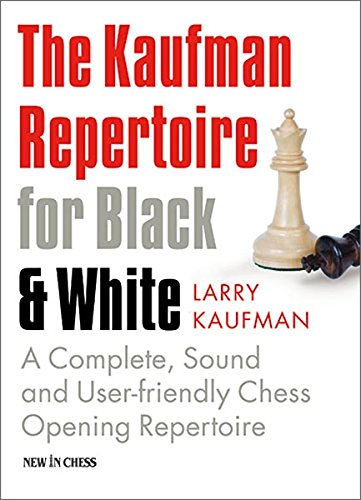
The Kaufman Repertoire for Black and White: A Complete, Sound and User-friendly Chess Opening Repertoire, by Larry Kaufmann

PDF Ebook The Kaufman Repertoire for Black and White: A Complete, Sound and User-friendly Chess Opening Repertoire, by Larry Kaufmann
The Kaufman Repertoire For Black And White: A Complete, Sound And User-friendly Chess Opening Repertoire, By Larry Kaufmann Exactly how can you alter your mind to be much more open? There several sources that can assist you to improve your thoughts. It can be from the various other experiences and story from some people. Schedule The Kaufman Repertoire For Black And White: A Complete, Sound And User-friendly Chess Opening Repertoire, By Larry Kaufmann is among the trusted sources to get. You could locate so many publications that we share here in this website. And also currently, we reveal you one of the very best, the The Kaufman Repertoire For Black And White: A Complete, Sound And User-friendly Chess Opening Repertoire, By Larry Kaufmann
Well, publication The Kaufman Repertoire For Black And White: A Complete, Sound And User-friendly Chess Opening Repertoire, By Larry Kaufmann will make you closer to just what you want. This The Kaufman Repertoire For Black And White: A Complete, Sound And User-friendly Chess Opening Repertoire, By Larry Kaufmann will certainly be always buddy at any time. You might not forcedly to constantly complete over reviewing a book in other words time. It will be just when you have leisure and also spending couple of time to make you feel pleasure with exactly what you read. So, you can obtain the meaning of the message from each sentence in guide.
Do you recognize why you should review this site and also exactly what the relation to checking out e-book The Kaufman Repertoire For Black And White: A Complete, Sound And User-friendly Chess Opening Repertoire, By Larry Kaufmann In this modern-day era, there are lots of methods to obtain the e-book and also they will certainly be a lot easier to do. One of them is by getting the e-book The Kaufman Repertoire For Black And White: A Complete, Sound And User-friendly Chess Opening Repertoire, By Larry Kaufmann by on-line as exactly what we inform in the web link download. Guide The Kaufman Repertoire For Black And White: A Complete, Sound And User-friendly Chess Opening Repertoire, By Larry Kaufmann could be a selection considering that it is so correct to your need now. To get the publication online is really simple by only downloading them. With this possibility, you could review guide wherever and also whenever you are. When taking a train, awaiting listing, and also awaiting someone or various other, you could read this on-line publication The Kaufman Repertoire For Black And White: A Complete, Sound And User-friendly Chess Opening Repertoire, By Larry Kaufmann as a great close friend once more.
Yeah, checking out a publication The Kaufman Repertoire For Black And White: A Complete, Sound And User-friendly Chess Opening Repertoire, By Larry Kaufmann could include your pals listings. This is just one of the solutions for you to be effective. As recognized, success does not indicate that you have fantastic points. Recognizing and also recognizing greater than various other will certainly provide each success. Close to, the message and perception of this The Kaufman Repertoire For Black And White: A Complete, Sound And User-friendly Chess Opening Repertoire, By Larry Kaufmann can be taken and selected to act.
Every competitive chess player needs to decide which openings he wants to play. Selecting a set of moves to employ, with either white or black, against each likely countermove by your opponent is a daunting challenge that takes a lot of time and effort.Grandmaster and former senior world champion Larry Kaufman provides a ready-to-go repertoire for both colors that is based not on what on what is objectively ‘best' (meaning the most popular in recent grandmaster play), but on what is easy to digest for amateurs. Kaufman has selected a range of sound lines that do not outdate rapidly, do not require the memorization of lots of theory and can be played with confidence. The recommended openings are not razor-sharp but contain enough venom for the white side to strive for a clear advantage and for sufficient counter-chances on the black side. Kaufman presents his material with a good balance between narrative and variations and also provides common-sense guidance on how to evaluate positions. This manual, a completely revised and updated edition of ‘The Chess Advantage in Black and White', provides a practical and reliable chess opening repertoire for a broad audience.
- Sales Rank: #595118 in Books
- Brand: The House of Staunton
- Published on: 2012-04-16
- Original language: English
- Number of items: 1
- Dimensions: 9.31" h x 1.21" w x 6.87" l, 2.01 pounds
- Binding: Paperback
- 496 pages
Features
- Author: Larry Kaufman
- Pages: 496 Pages
- Publication Years: 2012
Review
Kaufman isn't fobbing the public off with Mickey Mouse sidelines. He keeps thinkgs simple, but lucid. The book serves a purpose and does this very wll. I have been hunting for something like this for a while. Thanks, Mr. Kaufmann, my search is over!
--International Grandmaster Glenn Flear
The various systems are well thought-out and link up with each other almost perfectly. I liked the abundant verbal explanations a lot.
--Martin Rieger, Europa Rochade Magazine
Kaufman focuses on active, strategically sound variations. Stronger players will be able to quickly scan an opening and pick up ideas, while the openings are indeed also suitable for the average player. Pleasant to read and easy to handle - Extremely useful.
--International Master Arthur van de Oudeweetering, Chess Vibes
About the Author
Father Larry Kaufmann is the current provincial for the Redemptorist Province of South Africa. As provincial, he is the primary contact person for Redemptorist Pastoral Publications in South Africa.
Most helpful customer reviews
91 of 95 people found the following review helpful.
excellent 1-volume repertoire coverage
By popcorn
There is an excellent Youtube video of an IM covering this book and its repertoire in detail. Search Youtube for "Book Review The Kaufman Repertoire" by Chessexplained. It's 53 minutes long, though, so if you want a shorter summary, I'll list the main lines below. Also, the publisher has released an excerpt which includes the author's introduction with comments about his selections.
In general I agree with the previous poster. The long algebraic notation is a bit unwieldy, but it should be noted this notation is only used in bold on the main lines, while discussion of alternative moves and game examples are given in figurine algebraic. The intention seems to have been to make the main lines stand out from the analysis. And yes, the book promises a near-refutation of the King's Indian Defense. The idea given does appear very strong, but any club player can tell you what a nightmare the Mar del Plata variation can be to face over the board. The fact that White has destroyed Black's queenside and that theory says White should win doesn't help much when you see your king stuck in a corner getting mated. There is an alternative line given against the King's Indian for those of us with an aversion to pain.
This book is a marked change from the previous "The Chess Advantage in Black and White" by the same author. He seems to have backed away slightly from his "second best" philosophy and gone with more topical lines. For white, Kaufman switches from 1.e4 to 1.d4 2.c4 with fairly conservative variations, such as the Exchange variation against the Queen's Gambit Declined. He abandons the Semi-Slav because of problems in the Bg5 lines, instead relying on the Grunfeld, and in many cases giving several lines of various temperaments to choose from. His recommendation against the Scotch has also changed, and he has switched from the Berlin to the Breyer variation of the Ruy Lopez. He gives the reasoning for his choices, the most common being the latest computer analysis and the fact that Magnus Carlsen plays most of these lines.
The book is larger, easier to read, and printed on better quality paper than the previous work. In my opinion the coverage is aimed for a slightly stronger reader than the previous work. The book has an excellent index and a brief discussion of the author's experiences with the lines. The odd format bothered me less than I thought it would. The white repertoire is given in the front of the book and takes up a little over half the book. Flip the book over and you have the black repertoire. As in all one-volume opening books, there is no room for exhaustive coverage. You will quickly find lines that are not included and your opponents will often vary from this repertoire at an early stage. That said, the lines here are mostly well-chosen, with good examples from complete or partial games, and the reader will have some idea of what the plans are in each major variation. I have found the book has served me well even in those variations not directly covered.
The Repertoire:
For White against the major defenses:
-Queen's Gambit Declined Exchange variation with Nf3
-2.Bg5 vs the Dutch
-Bf4 lines against the Benoni
-3.e4 against the Queen's Gambit Accepted. 3.Nf3 is also covered.
-6.Ne5 lines against the Slav
-5.Bg5 vs the Semi-Slav
-5.Qb3, the Russian System, vs the Grunfeld
-h4!, with proper timing, against the King's Indian Defense Mar del Plata. 8.Be3 is given as a backup.
-Qc2 vs the Nimzo-Indian, and also coverage of the Queen's Indian
-he includes a chapter on starting with 1.Nf3.
For Black:
Against queen pawn or flank openings we play the Grunfeld or similar structures:
-Grunfeld ..Qxa2 pawn-grab lines against the Modern Exchange (with Rb1)
-10. ..Qc7 vs the old exchange variation (with Bc4, Ne2, etc), and 10. ..e6 and 10. ..b6 as backups
-1. ..g6 vs the English, usually with c5 to follow
-several chapters cover anti-gruenfeld, Reti, Neo-Grunfeld (where white fianchetos his king's bishop), The Trompowski, London system, etc. Many lines are in the spirit of the Grunfeld while some alternatives given resemble the Queen's Indian or Queen's gambit declined
Against 1.e4 we play 1. ..e5:
-3. ..Bc5 in the Italian Game
-against the Bishop's Opening and Vienna, 1.Nf6 and c6 planning a quick d5
-against the King's Gambit 1.e4 e5 2.f4 d5 3.exd exf, which is not only solid, it prevents the Bishop's Gambit
-against the Evan's Gambit, 5. ..Ba5 6.d4 d6 7.Qb3 Qd7 Or alternatively the safer 5. ..Be7
-against the Scotch 4...Nf6 5.Nxc6, bxc6 6.e5 Qe7 7.Qe2 Nd5 8.c4 Nb6
-the Breyer variation against the Spanish
-there is also a chapter on the many sidelines of the Spanish, including an interesting line against the Spanish exchange: 4.Bxc6 dxc6 5.0-0 Bg4 6.h3 h5 7.d3 Qf6
Coverage of less common lines is also included, though some of the really absurd lines are not covered.
In all, this is by far the best one-volume opening repertoire I have found. The choices have a nice blend of time-tested reliability and modern dynamism about them, and they are both solid and resilient. There is always a chance to play for advantage, and your opening will not be busted with one line your opponent has memorized. The openings are the highest quality, not gimmick systems, and so they require work and practice for those new to them. But the rewards are very high, not only in results, but in chess understanding and a greater appreciation for chess history of the last 200 years and what past masters were able to accomplish without computers. Not every line or question can be addressed in one volume, but I believe Mr Kaufman has done an excellent job of choosing his coverage well, both with main lines and analysis. Naturally, strong players will want more detailed books on specific variations, but imo, this book gives more than enough coverage for the average club player until at least near-expert strength.
Highly recommended.
37 of 39 people found the following review helpful.
A suitability litmus test
By C. Amari
Here is a simple litmus test to determine if this book is right for you. Be honest. Would the likelihood of your competition leading (or following) you into the far depths of theory of the Hungarian Variation of the Russian System of the Grunfeld Defense resemble the likelihood of a monkey typing Shakespeare? If so, you can pass this up.
Likewise, are you looking for efficiency, an occasional gambit, and relatively early sidelines that, while not altogether sound against a GM, are more than adequate against your opposition while sidestepping months of memorization? Against your competition, can you realistically aspire to an opening advantage that would register more than 0.31 in your favor by a strong computer assessment? If so, then this book is NOT for you.
I have a lot of respect and admiration for this book, but I have to conclude that it is hardly useful for "club" players, and not what they typically are looking for in a "repertoire" book. On the other hand, if in your games, you and your opponents are exploring the depths the Breyer Variation of the Ruy Lopez, the Grunfeld, and a lot of main line theory (or at least theory that tends to be quite popular nowadays among the elite) then this book may be for you.
Carlsen's openings are, in particular,the model for the Black side of this book. I think a lot of players should ask themselves whether study time devoted to Carlsen's approach to the opening is realistic and practical or whether, instead, someone along the lines of Aleksander Wojtkiewicz might serve as a more suitable exemplar.
The research for this book was an very real and practical exercise in developing an opening repertoire for a 2300-2400 player. If you are in the same boat, you are most fortunate, as the author's preparation is extraordinarily professional and workmanlike. Even in this case, however, the problem with repertoire choices like the Breyer and Grunfeld is that the treatment of those complexities in a book that touches on nearly every other opening choice may not be sufficient. It is, however, an solid start.
36 of 39 people found the following review helpful.
Excellent Repertoire for the Club Player
By Christopher J. Falter
International Grandmaster Larry Kaufman is best known in chess circles for authoring the evaluation function in Rybka 3 and for co-creating the super-strong Komodo engine. In this one-volume repertoire Kaufman has extensively researched promising opening lines for both sides with the Houdini and Komodo engines (running on a 12-core processor!). However, he does not simply regurgitate the computer analysis in this book; instead, he succinctly explains why particular continuations are good for one side or the other.
The goal of his repertoire for the white player is a stable advantage with dynamic chances. He recommends 1. d4 followed by 2. c4, and what comes next depends on black's response. In general, white can emerge with at least one of these 4 advantages:
* An extra center pawn
* More space
* More material (including the bishop pair)
* Superior development
He notes that Kasparov played most of the repertoire recommendations at some point, so you're in good company if you use the Kaufman white repertoire.
While I have not analyzed the entire white repertoire in depth, I can comment on a couple of lines that caught my attention:
* King's Indian Defense: Kaufman's faith in the Mar del Plata variation against the KID (1. d4 Nf6 2. c4 g7 3. Nc3 Bg7 4. e4 d6 5. Nf3 O-O 6. Be2 e5 7. O-O Nc6 8. d5 Ne7 9. Ne1) is quite touching; as he describes it, "White allows Black a scary-looking attack, but hard analysis seems to show that white just wins material on the queenside and beats off the attack." Of course, the engines' near-perfect defensive abilities color their favorable evaluation for white, but the average club player needs a lot of nerve to play this way. Don't let me discourage you, though; what's life for if not for taking some well-considered risks? For the less adventurous, Kaufman provides a second suggestion (starting with 8. Be3) that gives "a safe route to a modest advantage."
* Benko Gambit: Kaufman recommends trading the light-squared bishops and castling by hand (1. d4 Nf6 2. c4 c5 3. d5 b5 4. cxb5 a6 5. bxa6 g6 6. Nc3 Bxa6 7. e4 Bxf1 8. Kxf1 d6 9. Nf3 Bg7 10. g3 O-O 11. Kg2 Nbd7), followed by the recent novelty 12. a4, planning to stick a knight on b5. He follows the game Zhou-Wang 2011 (rapid), and deems black's compensation insufficient provided white improves with the engine-recommended 22. Qxb3. In my opinion, though, black could have improved a few moves earlier to obtain the typical Benko compensation. So if you like to play the Benko, don't give it up because of Kaufman's repertoire. On the other hand, Kaufman's suggestion does yield a modest advantage for white (even if black improves), so Kaufman has delivered the goods for his readers.
For the black player, Kaufman's goal is a comfortable near-equality with enough dynamic chances to score the full point if white plays a couple of weak moves. His analysis points him to some of Magnus Carlsen's recent favorites: the Gruenfeld Defense and the Breyer Variation of the Ruy Lopez. White has so many options against the Gruenfeld (1. d4 Nf6 2. c4 g6 3. Nc3 d5) that it is difficult to summarize the main ideas for black, other than to say that black never lacks for counterattacking weapons. The Breyer Variation (1.e4 e5 2. Nf3 Nc6 3. Bb5 a6 4. Ba4 Nf6 5. O-O Be7 6. Re1 b5 7. Bb3 d6 8. c3 O-O 9. h3 Nb8), on the other hand, is not so hard to understand: "Black's knight will be on d7 rather than c6, which makes the bishop fianchetto to b7 attractive. Black will usually fianchetto both bishops, will usually answer a2-a4 by ...c5-c4 and ...Nc5, will aim for ...c7-c6 against an early d4-d5, and will sometimes get in the shot ...d6-d5 himself."
There's a lot to like in this opening tome:
1. The opening recommendations are solid but do not lack dynamic possibilities.
2. Kaufman's extensive use of chess engines have yielded a lot of novelties. For example, in the "fork trick" line of the Four Knights (1. e4 e5 2. Nf3 Nc6 3. Nc3 Nf6 4. Bc4 Nxe4 5. Nxe4 d5 6. Bd3), he unleashes the engine-recommended 6...Nb4! and demonstrates full equality for black in further analysis.
3. He provides an index of variations and an index of players, which are of course essential for a repertoire book.
4. He closes with a chapter on "The Repertoire in Practice," in which he analyzes some game excerpts from his participation in the 2011 US Open and the 2011 Atlantic Open. He was quite satisfied with the positions the repertoire yielded, although in many cases he would confess "now I missed 19. Qe3! ...", and then in the next game "I should have played 14...Ne5! with full equality...," and so forth. Proof that you need more than a good opening repertoire to play good chess!
Overall, packing an entire repertoire into one book offers great value, as it provides a complete reference at a very modest cost. On the other hand, Kaufman necessarily had to cut some corners to fit everything into a single book. The game analyses focus on opening choices, rather than typical middlegame themes and plans; typical endgames are never explored; and the reasons behind evaluations are extremely brief (e.g., in game 13.6 of Avoiding the Nimzo-Indian, "White has the bishop pair in a fairly balanced position"--when in fact white has an isolated c pawn on an semi-open file, black has an isolated d pawn on a semi-open file, white's knight on d4 is more active than either of black's knights, etc.). It's not a bad trade-off for most club players; instead of buying 10 in-depth opening books, buy Kaufman's repertoire and then 9 great books on tactics, strategy, endgame technique, etc. You'll probably be a lot better off!
In fact, I'd recommend purchasing this book even if you're not planning to play Kaufman's repertoire for yourself, because you'll probably be playing against it a fair amount over the next few years. Be prepared, as the Boy Scouts say.
Full disclosure: The publisher provided a review copy of this book to me. My ratings of the publisher's books have ranged from 3 stars to 5 stars.
See all 15 customer reviews...
The Kaufman Repertoire for Black and White: A Complete, Sound and User-friendly Chess Opening Repertoire, by Larry Kaufmann PDF
The Kaufman Repertoire for Black and White: A Complete, Sound and User-friendly Chess Opening Repertoire, by Larry Kaufmann EPub
The Kaufman Repertoire for Black and White: A Complete, Sound and User-friendly Chess Opening Repertoire, by Larry Kaufmann Doc
The Kaufman Repertoire for Black and White: A Complete, Sound and User-friendly Chess Opening Repertoire, by Larry Kaufmann iBooks
The Kaufman Repertoire for Black and White: A Complete, Sound and User-friendly Chess Opening Repertoire, by Larry Kaufmann rtf
The Kaufman Repertoire for Black and White: A Complete, Sound and User-friendly Chess Opening Repertoire, by Larry Kaufmann Mobipocket
The Kaufman Repertoire for Black and White: A Complete, Sound and User-friendly Chess Opening Repertoire, by Larry Kaufmann Kindle
The Kaufman Repertoire for Black and White: A Complete, Sound and User-friendly Chess Opening Repertoire, by Larry Kaufmann PDF
The Kaufman Repertoire for Black and White: A Complete, Sound and User-friendly Chess Opening Repertoire, by Larry Kaufmann PDF
The Kaufman Repertoire for Black and White: A Complete, Sound and User-friendly Chess Opening Repertoire, by Larry Kaufmann PDF
The Kaufman Repertoire for Black and White: A Complete, Sound and User-friendly Chess Opening Repertoire, by Larry Kaufmann PDF